


Syllabus: GS3/ Economy
Context
- The Government of India has recently undertaken a comprehensive overhaul of its statistical databases by updating the methodologies, base years, and coverage of key economic indicators.
Need for Overhaul of Statistical Databases
- International Concerns: In 2025 the Indian government received a ‘C’ grade, the second-lowest grade, by the International Monetary Fund for the quality of its national accounts statistics.
- Representation of Current Scenario: The databases were outdated and were becoming less representative of reality with each passing year.
- An outdated base year weakens the overall measurements and makes them less representative of the current reality.
- Outdated Base Years: In the decade since 2011-12, India’s economy has transformed drastically, with new industries emerging (e.g. renewable energy, digital services) and changes in consumption patterns and investment behaviour.
- Such structural changes necessitate rebasing so that metrics capture true contribution of growing sectors and changes in technology and productivity.
What are the Metrics that Have Been Updated?
- National Accounts and GDP Reforms: GDP is the total monetary value of all final goods and services produced within a country’s domestic territory during a specific period.
- India has revised its GDP base year from 2011–12 to 2022–23.
- The revised series applies the double deflation method in agriculture and manufacturing, which separately accounts for changes in input prices and output prices.
- Consumer Price Index (CPI): Price changes at the retail level, which is meant to capture the consumer-end of the market, are measured by the CPI.
- The base year of the CPI was updated to 2024, and the basket of items it measures as well as their relative weightages were pegged to the latest Household Consumption Expenditure Survey of 2023-24.
- Wholesale Price Index (WPI): Price changes at the wholesale level, which is ideally meant to capture the prices that producers get, are measured by the WPI.
- The WPI base year has been updated to 2022-23 and the number of items expanded from 697 to 957.
- Index of Industrial Production (IIP): IIP is a key indicator that measures how industrial production is changing over time.
- It is a monthly indicator which reflects the monthly changes in the volume of production of a representative basket of industrial products, with reference to a specified base year.
- The base year of the All India Index of Industrial Production (IIP) has been revised from 2011-12 to 2022-23.
- Adoption of Producer Price Index (PPI): The PPI separately tracks the prices producers pay for inputs and the prices they receive for their outputs.
- The PPI excludes additional costs such as transport and indirect taxes, which the WPI includes.
- This makes the PPI a more accurate representation of prices at the producer level. It also incorporates both goods and services, which makes it more holistic.
- Introduction of Quarterly Bulletins on Unincorporated Sector Enterprises (QBUSE): Starting 2025, QBUSE has been introduced, providing interim results every quarter instead of waiting for an annual report.
- The quarterly data are intended to capture short-term movements in the sector.
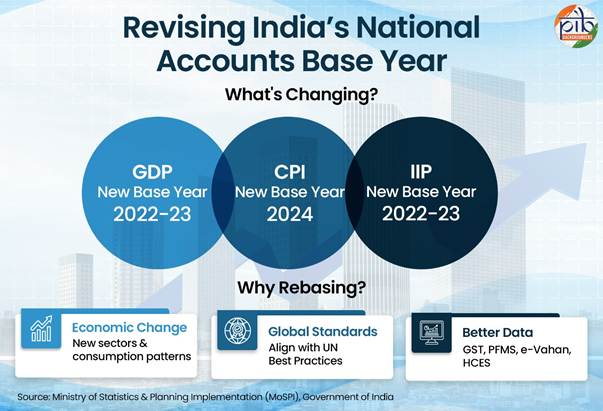
Rationale for Selecting 2022-23
- The year 2022-23 was chosen as the new base because it is the most recent “normal” year after the disruptions of 2019-2021.
- The years 2019-20 and 2020-21 were significantly affected by the COVID-19 pandemic, which temporarily altered consumption patterns and industrial output.
Significance of the Statistical Reforms
- Strengthen Evidence-Based Governance: As the data is more reliable it enables governments to formulate better policies and monitor outcomes more effectively.
- Improve Monetary Policy: Accurate inflation estimates help the Reserve Bank of India calibrate interest rates more effectively. Also better inflation measurement supports macroeconomic stability.
- Increase Growth Measurement: The updated GDP, GVA, and IIP data will provide a realistic picture of the country’s economic performance.
- International Credibility: The adoption of global best practices will improve India’s standing in international statistical assessments. Also the reliable economic statistics will enhance investor confidence and policy credibility.
Concluding remarks
- The recent statistical reforms mark a decisive shift in India’s statistical system towards greater relevance, responsiveness, and credibility.
- Sustained efforts to improve data quality and ensure regular updates will be critical for strengthening evidence-based policymaking and economic governance.
Previous article
India’s Cultural Diplomacy
Next article
Building India’s Space Future
